When my kids do things, I often find myself thinking of it as an analogy to how we are all children of God. You know... they whine to me; I whine to God. I love them even when they're dirty and annoying; God loves me even when I'm fat and sloppy and cranky.
So today I was changing Julie's diaper on my bed. When I was done, I shifted her over and laid Gabe down on the bed next to her, so I could change him too. She had a blanket on the other side of her, so she tried to roll over in Gabe's direction. I just barely managed to keep her foot from going straight into his just-opened, quite-poopy diaper.
And I thought, "Hmm, yep."
Sometimes you want something and go after it and God just has to say, Don't do that. And you don't know why, because what's the harm in trying to roll over? But He's really just trying to keep you from putting your foot in a stinky mess.

Showing posts with label Theory. Show all posts
Showing posts with label Theory. Show all posts
Friday, June 17, 2011


Friday, April 29, 2011
"As"
I was thinking about Jennifer @ Conversion Diary’s resolve to put up a post about the meaning of every single word of the Our Father, and I was picking out in my mind the difficult ones - “in”, “thy”, “as”, “it”. That was just how it seemed to me - as if, flowing along the words of that phrase, “thy will be done on earth as it is in heaven”, this one word, “as”, was written in bold. What did it mean? Why did that word suddenly strike me as profound, in a nonspecific sort of way?
So I started thinking about what that word, “as”, meant. It reminded me of another “as”, the one where Jesus says “Be perfect as your heavenly Father is perfect.”(Matt 5:48). That phrase has provided a dilemma for me, a riddle. The saints and theologians all seem to say that we cannot actually attain perfection in this life, only in the next. But if so, why would Jesus say it?
And pondering it, I suddenly saw something.
Life is an asymptote.
For those of you less familiar with mathematical terms, an asymptote is one of those funny things that you get with certain equations, (most often when you get close to dividing by zero). If you have an asymptote, the graph of your equation will never quite touch some line that it is getting close to - but it will literally never stop getting closer and closer to it, either.
Let’s say that God’s will as it is done in heaven is 42*. Praying that God’s will be done on earth as it is in heaven means that you’re not satisfied with 40 on earth. It means that if the earth reached 41.9, you wouldn’t stop and say “This is good enough for me. I’m staying here.” You don’t let things just level off, remaining a permanently fixed distance from perfection. Even at 41.99999999999, you’re still striving, still fighting the good fight to inch us that much closer to God’s will as it is in heaven.
It’s important that we remember that God always loves us, whether we’re at 40 or a negative billion. We don’t say “as”, as if our eternal lives depended on reaching that “as” on earth. Our peace, our joy in God comes long before we approach perfection. But we keep striving for it, yearning for it, and praying for it, because we know that every little bit closer that we get, is totally worth it.
* If you’re on the internet and don’t know why I picked 42, I’d be a little shocked. But if so, go see 42.
So I started thinking about what that word, “as”, meant. It reminded me of another “as”, the one where Jesus says “Be perfect as your heavenly Father is perfect.”(Matt 5:48). That phrase has provided a dilemma for me, a riddle. The saints and theologians all seem to say that we cannot actually attain perfection in this life, only in the next. But if so, why would Jesus say it?
And pondering it, I suddenly saw something.
Life is an asymptote.
For those of you less familiar with mathematical terms, an asymptote is one of those funny things that you get with certain equations, (most often when you get close to dividing by zero). If you have an asymptote, the graph of your equation will never quite touch some line that it is getting close to - but it will literally never stop getting closer and closer to it, either.
Let’s say that God’s will as it is done in heaven is 42*. Praying that God’s will be done on earth as it is in heaven means that you’re not satisfied with 40 on earth. It means that if the earth reached 41.9, you wouldn’t stop and say “This is good enough for me. I’m staying here.” You don’t let things just level off, remaining a permanently fixed distance from perfection. Even at 41.99999999999, you’re still striving, still fighting the good fight to inch us that much closer to God’s will as it is in heaven.
It’s important that we remember that God always loves us, whether we’re at 40 or a negative billion. We don’t say “as”, as if our eternal lives depended on reaching that “as” on earth. Our peace, our joy in God comes long before we approach perfection. But we keep striving for it, yearning for it, and praying for it, because we know that every little bit closer that we get, is totally worth it.
* If you’re on the internet and don’t know why I picked 42, I’d be a little shocked. But if so, go see 42.
Wednesday, April 13, 2011
Mary of Bethany
The gospel this past Sunday was the story of Lazarus coming back from the dead. I didn't hear most of the homily that the seminarian at our parish gave (a combination of distracting kids and just plain wandering thoughts). But I tuned in for about ten seconds when he said something about Mary of Bethany being the same sinful woman who had washed Jesus' feet with her tears, and then (I think) something comparing the two incidents in Mary's life.
Now, frankly, I'm not a big fan of the theory that says that the woman who washed Jesus' feet with her tears was Mary of Bethany or Mary of Magdalene or both. It's ok, I guess, as speculation, but claiming it as fact is really stretching things.
However, I suddenly saw that making the two woman into the same person does something.
It makes Mary a two-story person.*
So many of the figures in the Bible, whether Old Testament or New, have only one story told about them. Jonah's story begins and ends with Ninevah. The blind man is healed. The lepers are healed. What happens to them ten years later? We don't know. Did God do anything significant in Naomi's life after she married Boaz and had a son? We don't know. The centurion whose had such great faith that his servant was healed - was that the limit of his encounter with God? We aren't told.
 |
| (Pictures In Church) |
There's a few exceptions - Abraham, Moses, Jesus himself come to mind. Peter and Paul. But these are, generally, the "greats". It's easy to think of them as somehow being on a totally different plane than us mere mortals.
 |
| (Woman Weaving) |
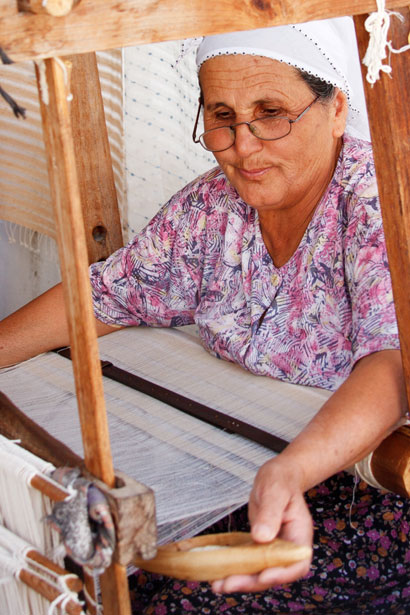
But Mary is different. This isn't even Mary the mother of God; this is just Mary of Bethany, sister of Martha and Lazarus. She might be special, but she's not out of reach.
And if she can have repeated significant encounters with God, then so can we.
Because sometimes it's easy to forget that. Sometimes it's easy to think of ourselves as one-story people. And if we do, if we think our encounter with God has come and gone, then we won't be looking out for all the new encounters with him that He has planned.
*Yes, I know that Mary already has two stories: the Lazarus story and the "Make her help me with the dishes" story. But I never had this insight before when thinking about those two stories, so this the way I'm writing it.
Friday, April 1, 2011
War And Innocent Life
So this past Monday, during the social time after my prayer meeting, I got into a discussion with three of the guys about the atom bombing of Hiroshima and Nagasaki and about war in general.
It was as if something had come over me. I was making these bold, passionate statements instead of my usual calm, carefully nuanced ones. I was making simple, elegant points instead of tripping over my own complicated logic, which is more the norm for me (especially in verbal conversations). Talking afterward with one of the ladies who had been listening, she told me, "Stay on your soapbox". I think it was the Spirit moving in me, so I'm going to put a spiel about this up on my blog, too.
*****************************************************
So here's the thing. It really, really matters when innocent civilians get killed. Killing one innocent civilian is, yes, just as evil as aborting one innocent baby. Because it's the same thing. It doesn't matter if you come from a family with a long military tradition and you've always been taught that you do whatever you need to do in war, that there's no way to wage a war without killing civilians, and we should just accept that and get over it. There are families out there, too, who think that abortion is just fine. That doesn't make it right.
You think there's no way to wage a war justly anyhow, so it doesn't matter? I tell you, yes there is a right way to do it. And one of the requirements for doing it right is this. That you have to do every. possible. thing. to make sure that no innocent civilians get killed. I feel that I cannot emphasize this enough. Everything in your power. EVERYTHING.
War is like self-defense. When someone attacks you, you're allowed to fight back. All those soldiers out there - they're attacking you. It's ok if you fight back. It's NOT ok if you start killing someone who wasn't attacking you. Civilians are not soldiers. It doesn't matter if they support the regime that is attacking you. It doesn't matter if they voted for Hitler. It doesn't matter if they donated money to Stalin. If they're "spiritually attacking" you, fine. Attack them back spiritually. With prayer. You don't get to use physical force or kill someone unless they are attacking you - physically attacking you - first. If Ralph points a gun at you, you don't get to shoot his friend Tom who's standing by cheering him on, because Tom isn't attacking you.
Yes, the Vietnam war offered an exception to the idea that civilians are not soldiers. Knowing that even kids might have bombs strapped to them is horrible and I'm not going to judge anyone who shot a kid to defend themselves. But that's an exception. That's not how most of our wars have been fought, and we can't act as if that were the norm where it's not.
The atom bomb - that was unjustifiable. We dropped an atom bomb on cities. Cities! Cities full of women and children and elderly, normal folks going about their business as best they could. And we killed them. And not in a quick and simple way, either, but in a way that left many of them in painful, lingering deaths over the course of a couple months. Imagine for a second that, after we invaded Iraq, Saddam Hussein had dropped a nuclear bomb on Savannah, Georgia. Let's even say that there was a military base stationed in or around the city. We would all be pretty horrified, wouldn't we? We wouldn't say, "Oh, this is awful, but it's war, and he was justified. He was probably even trying to save lives by ending the war sooner by showing us how powerful and dedicated he is so we wouldn't keep fighting. And there was a military base there, so it was a valid military target, even though hundreds of thousands of civilians died." Yet that's the way people talk about Hiroshima and Nagasaki. It's lunacy. Don't think this way, people!
Do you think this is just about the atom bomb? It's not. It's not even mostly about the atom bomb. That's done. It already happened and there isn't anything we can do to change it. But guess what? This problem is still going on.
What, you say? You don't believe that America has a problem with killing innocent civilians? Let me refer you to the article that I had looked at the morning before I got into a debate about all this: The Kill Team Photos. I think I got through two photos before they were too graphic for me. Or maybe you should go read some of those Wikileaks documents about what our soldiers do. Yes, Assange appears to be an arrogant jerk, and yes, national security should be respected. But you know what? It's a lot like the Catholic Church and the sex abuse scandal. The reporters may be biased jerks out to paint you in the worst light possible. But when they show up this nasty thing that's going on, you shouldn't dither around accusing them and insisting they shouldn't have made it public. The most important thing is to, as my brother put it after seeing some of the Wikileaks publications, "stop being evil". Stop letting the soldiers get away with killing civilians. Stop dropping bombs on areas where civilians are likely to be. Pay attention to the civilians. Don't dismiss them as beneath your notice.
Need more convincing? Try these estimates of Iraqi deaths. The Wikileaks estimates are the smallest ones there, and the civilian deaths are over half of the total death count. That means that for every soldier or terrorist we kill, we've killed at least one civilian, too, if not three. Picture if you were living in enemy-occupied territory, and your brother Paul was part of the resistance movement. So a soldier breaks in, kills Paul, and then shoots your brother Mack, too, even though Mack wasn't part of the resistance or doing anything other than trying to go to work and live his life. No wonder they hate us. We treat them like crap.
And Iraq and Afghanistan isn't the only recent issue. Americans want to rejoice over our intervention in Libya. We're the good guys coming to the side of the oppressed people who are just trying to get rid of their evil dictator, right? Err... perhaps it's not so simple. Aside from the possibility that the fighting is more of a civil war between two tribes that don't like each other instead of a fight against an oppressive regime, there is the fact that our intervention is putting civilians at risk. Here's a quote from the article I read today:
Hear that, you Americans? This isn't "that barbaric Ghadafi is bombing a hospital, see how uncivilized he is."... this is NATO bombing a hospital. Us. We're doing it. We're the bad guys. That wasn't a target? So what. We still damaged it.
Read that whole article yet? It says the Pope is concerned about civilian deaths. Hear that, my Catholic friends? The Pope is worried about civilians dying in Libya. Don't you think, oh, maybe, that it's our job to follow his lead and do anything we can to prevent civilian deaths?
I'm not being a pacifist here. I'm not saying we shouldn't be intervening in Libya. I'm saying that we need to do every single thing that we possibly can to avoid civilian deaths. And we aren't doing that right now.
It was as if something had come over me. I was making these bold, passionate statements instead of my usual calm, carefully nuanced ones. I was making simple, elegant points instead of tripping over my own complicated logic, which is more the norm for me (especially in verbal conversations). Talking afterward with one of the ladies who had been listening, she told me, "Stay on your soapbox". I think it was the Spirit moving in me, so I'm going to put a spiel about this up on my blog, too.
*****************************************************
So here's the thing. It really, really matters when innocent civilians get killed. Killing one innocent civilian is, yes, just as evil as aborting one innocent baby. Because it's the same thing. It doesn't matter if you come from a family with a long military tradition and you've always been taught that you do whatever you need to do in war, that there's no way to wage a war without killing civilians, and we should just accept that and get over it. There are families out there, too, who think that abortion is just fine. That doesn't make it right.
You think there's no way to wage a war justly anyhow, so it doesn't matter? I tell you, yes there is a right way to do it. And one of the requirements for doing it right is this. That you have to do every. possible. thing. to make sure that no innocent civilians get killed. I feel that I cannot emphasize this enough. Everything in your power. EVERYTHING.
War is like self-defense. When someone attacks you, you're allowed to fight back. All those soldiers out there - they're attacking you. It's ok if you fight back. It's NOT ok if you start killing someone who wasn't attacking you. Civilians are not soldiers. It doesn't matter if they support the regime that is attacking you. It doesn't matter if they voted for Hitler. It doesn't matter if they donated money to Stalin. If they're "spiritually attacking" you, fine. Attack them back spiritually. With prayer. You don't get to use physical force or kill someone unless they are attacking you - physically attacking you - first. If Ralph points a gun at you, you don't get to shoot his friend Tom who's standing by cheering him on, because Tom isn't attacking you.
Yes, the Vietnam war offered an exception to the idea that civilians are not soldiers. Knowing that even kids might have bombs strapped to them is horrible and I'm not going to judge anyone who shot a kid to defend themselves. But that's an exception. That's not how most of our wars have been fought, and we can't act as if that were the norm where it's not.
The atom bomb - that was unjustifiable. We dropped an atom bomb on cities. Cities! Cities full of women and children and elderly, normal folks going about their business as best they could. And we killed them. And not in a quick and simple way, either, but in a way that left many of them in painful, lingering deaths over the course of a couple months. Imagine for a second that, after we invaded Iraq, Saddam Hussein had dropped a nuclear bomb on Savannah, Georgia. Let's even say that there was a military base stationed in or around the city. We would all be pretty horrified, wouldn't we? We wouldn't say, "Oh, this is awful, but it's war, and he was justified. He was probably even trying to save lives by ending the war sooner by showing us how powerful and dedicated he is so we wouldn't keep fighting. And there was a military base there, so it was a valid military target, even though hundreds of thousands of civilians died." Yet that's the way people talk about Hiroshima and Nagasaki. It's lunacy. Don't think this way, people!
Do you think this is just about the atom bomb? It's not. It's not even mostly about the atom bomb. That's done. It already happened and there isn't anything we can do to change it. But guess what? This problem is still going on.
What, you say? You don't believe that America has a problem with killing innocent civilians? Let me refer you to the article that I had looked at the morning before I got into a debate about all this: The Kill Team Photos. I think I got through two photos before they were too graphic for me. Or maybe you should go read some of those Wikileaks documents about what our soldiers do. Yes, Assange appears to be an arrogant jerk, and yes, national security should be respected. But you know what? It's a lot like the Catholic Church and the sex abuse scandal. The reporters may be biased jerks out to paint you in the worst light possible. But when they show up this nasty thing that's going on, you shouldn't dither around accusing them and insisting they shouldn't have made it public. The most important thing is to, as my brother put it after seeing some of the Wikileaks publications, "stop being evil". Stop letting the soldiers get away with killing civilians. Stop dropping bombs on areas where civilians are likely to be. Pay attention to the civilians. Don't dismiss them as beneath your notice.
Need more convincing? Try these estimates of Iraqi deaths. The Wikileaks estimates are the smallest ones there, and the civilian deaths are over half of the total death count. That means that for every soldier or terrorist we kill, we've killed at least one civilian, too, if not three. Picture if you were living in enemy-occupied territory, and your brother Paul was part of the resistance movement. So a soldier breaks in, kills Paul, and then shoots your brother Mack, too, even though Mack wasn't part of the resistance or doing anything other than trying to go to work and live his life. No wonder they hate us. We treat them like crap.
And Iraq and Afghanistan isn't the only recent issue. Americans want to rejoice over our intervention in Libya. We're the good guys coming to the side of the oppressed people who are just trying to get rid of their evil dictator, right? Err... perhaps it's not so simple. Aside from the possibility that the fighting is more of a civil war between two tribes that don't like each other instead of a fight against an oppressive regime, there is the fact that our intervention is putting civilians at risk. Here's a quote from the article I read today:
Even so, the Vatican has to consider what it’s hearing from [the Catholics in Libya] -- including a warning from the Apostolic Vicar of Tripoli, Bishop Giovanni Martinelli, that the NATO bombing is endangering civilians. For instance, he reported on Wednesday that two hospitals have been damaged and their patients sent into shock. [Source]
Hear that, you Americans? This isn't "that barbaric Ghadafi is bombing a hospital, see how uncivilized he is."... this is NATO bombing a hospital. Us. We're doing it. We're the bad guys. That wasn't a target? So what. We still damaged it.
Read that whole article yet? It says the Pope is concerned about civilian deaths. Hear that, my Catholic friends? The Pope is worried about civilians dying in Libya. Don't you think, oh, maybe, that it's our job to follow his lead and do anything we can to prevent civilian deaths?
I'm not being a pacifist here. I'm not saying we shouldn't be intervening in Libya. I'm saying that we need to do every single thing that we possibly can to avoid civilian deaths. And we aren't doing that right now.
Wednesday, March 9, 2011
Food Thoughts
Ok, so specialty eggs aren't more nutritious or better-tasting than regular "commercial" eggs, but "pastured" eggs *are* more nutritious. You can see on that last link that Cornucopia Institute rates various egg-producers. There is only one egg farm in Oregon that received their highest ranking: Phoenix Egg Farm. The closest place to get Phoenix eggs is 7 miles away. (Portland is an awesome place for the food-lovers movement, but the organic/local foods movement is mostly aimed at central/westside Portland, not here in the eastside ghettos). Not a convenient drive to make on a regular basis, just for better eggs. However, when the Gresham farmer's market opens back up, I might buy their eggs. I know I saw one of the farms that sold vegetables also having a few cartons of eggs to sell. They aren't really major egg producers, so they wouldn't be rated by Cornucopia, but I'm betting their chickens are pastured, simply because they probably don't have all that many of them, what with it being a vegetable farm rather than a major egg farm.
On dairy... I'm wondering about raw milk. Apparently there's a brand called Organic Valley (which Cornucopia gives a high rating on - although they don't explain what their ratings for dairy places is based on as well as they do for eggs) which makes a raw milk cheddar cheese, which I've been wanting to try the taste of. Unfortunately, they can't tell me if anyone close by actually carries any particular product (although I know I've seen Organic Valley milk at the grocery stores around, before). There's two "natural foods" stores in my area that I want to try out, and see what they have, in this and other categories.
Sour Salty Bitter Sweet - the blog that I'm reading through that has a number of articles which are a sort of insider, food-lover's critique of the Michael Pollan/Food, Inc. movement. (A movement which she once referred to as something like the new Church of Food and which someone else referred to as "Greener-than-thou". Since it's actually kind of difficult to put a single name on the movement, which has a number of branches with similar but different takes on which foods are the best, I'm going to call it the Pollan movement, since Michael Pollan is the biggest voice out there that I've seen. Anyhow, I'm thinking of asking the Sour Salty Bitter Sweet author for thoughts on raw milk/organic milk.
I like the taste of homemade bread better than storebought, and I really like trusting the ingredients instead of not really being sure what I'm getting, with store-bought breads. But I don't really like *making* homemade bread on a regular basis. Even the really simple and quick recipe that I found is too time-consuming for me to do every day or every few days or even every week. (And we eat a lot of bread here. Even given the fact that the kids don't like my homemade bread as well as storebought, mostly because it's crumblier, which makes it hard to hold a sandwich together). I don't know if I should just settle for Safeway brand 100% whole wheat bread, or pay more for Dave's Killer Bread (which is yummier, for me at least, and possibly healthier), or something else.
It did occur to me that if I made my own homemade applesauce, I could can it in single-serving Mason jars. I'm a little wary of the ingredients in store applesauces, and I definitely don't like the waste involved (packaging-wise) in single-serving store applesauces. But applesause and yogurt are two things that we don't eat if they aren't in single-serving containers. Call it laziness if you will, but I just can't run my day by having to stop what I'm doing every time one of the four kids wants a snack, go pour yogurt or applesauce into a bowl for them, and put it back in the fridge. The kids eat yogurt all the time, because when they ask me if they can have it, all I have to do is say "Sure", and they go get it out of the fridge, grab themselves a spoon, and eat it. I might have to take the top off for Savi and Gabe, but they grab the containers themselves and bring them over to wherever I'm doing whatever it is I'm doing, and I just peel the top off and hand it back to them. Easy peasy.
On the other hand, maybe if I do find a store applesauce whose ingredients I am comfortable with (do they have no-sugar-added applesauces?), I could just bring a large jar home and divide it up into single-serving mason jars at home and achieve the same effect, without all the hassle of actually trying to make my own applesauce. Large applesauce jars can usually be found in glass containers, which are recyclable, and very much preferred (by me) to the small plastic containers that (a) aren't recyclable (b) won't decompose in the next umpteen years and (c) contribute to that whole oil-dependence-on-the-middle-east thing that isn't good for us. The mason jars I could reuse indefinitely, I think, even if I did have to wash them. The more I think about that idea, the more I like it. Next time I go shopping, I'll have to look at applesauce ingredients. And buy some mini-mason jars. Or maybe what I think of as the regular size jars.
Which brings me to yogurt. The kids eat quite a bit of those single-serving flavored yogurts. When I was a kid, those were considered special treats for us, because they are more expensive than the large tubs of plain (unsweetened) yogurt. I tried giving my kids unsweetened yogurt once, and they didn't care for it. But it does seem to me that they get unnecessary/unhealthy amounts of sugar from those sweetened yogurts. And the constant waste of small plastic containers is rather obnoxious. Dividing the larger plastic containers up into mason jars would probably not be much better, although it might be worth it if I could switch them to plain yogurt at the same time, and have the cool new packaging be a selling point for it. I wonder if I could learn to make my own yogurt; my guess is that it would be more work than I'm really likely to put into it, especially given that homemade bread is too much for me, and I *love* that. But I will probably at least look it up. Might be easier getting higher-fat yogurts for Elijah that way, too.
And then there's the whole saturated fat/trans fat thing. The book Real Food first introduced me to the idea that saturated fat foods (think hamburgers and butter) don't actually cause heart disease, and that eating foods with cholesterol in them is not bad for you. (The book basically painted high cholesterol levels as the body's way of trying to repair damage that was caused by something else - mainly hydrogenated oils.) It is suddenly important to me to know whether or not any of that is actually *true* because Ken has developed high blood pressure. He's taking some meds, which have brought it down quite a bit, and the meds have made him nauseous when he eats fatty foods, which he thinks is healthy for him. And he lost 13 pounds, so it probably *is* healthy for him. But I would like to have some idea of how much I should be encouraging him to eat lower-fat options, and how much I should be targeting any efforts at some other culprit. Although, it probably wouldn't hurt to try to cut out all hydrogenated oils (which is more or less equivalent to trans fat) and still reduce his saturated fat content too.
I have a great photo to post, I think, but that will have to wait until I upload photos from the camera and all that jazz.
On dairy... I'm wondering about raw milk. Apparently there's a brand called Organic Valley (which Cornucopia gives a high rating on - although they don't explain what their ratings for dairy places is based on as well as they do for eggs) which makes a raw milk cheddar cheese, which I've been wanting to try the taste of. Unfortunately, they can't tell me if anyone close by actually carries any particular product (although I know I've seen Organic Valley milk at the grocery stores around, before). There's two "natural foods" stores in my area that I want to try out, and see what they have, in this and other categories.
Sour Salty Bitter Sweet - the blog that I'm reading through that has a number of articles which are a sort of insider, food-lover's critique of the Michael Pollan/Food, Inc. movement. (A movement which she once referred to as something like the new Church of Food and which someone else referred to as "Greener-than-thou". Since it's actually kind of difficult to put a single name on the movement, which has a number of branches with similar but different takes on which foods are the best, I'm going to call it the Pollan movement, since Michael Pollan is the biggest voice out there that I've seen. Anyhow, I'm thinking of asking the Sour Salty Bitter Sweet author for thoughts on raw milk/organic milk.
I like the taste of homemade bread better than storebought, and I really like trusting the ingredients instead of not really being sure what I'm getting, with store-bought breads. But I don't really like *making* homemade bread on a regular basis. Even the really simple and quick recipe that I found is too time-consuming for me to do every day or every few days or even every week. (And we eat a lot of bread here. Even given the fact that the kids don't like my homemade bread as well as storebought, mostly because it's crumblier, which makes it hard to hold a sandwich together). I don't know if I should just settle for Safeway brand 100% whole wheat bread, or pay more for Dave's Killer Bread (which is yummier, for me at least, and possibly healthier), or something else.
It did occur to me that if I made my own homemade applesauce, I could can it in single-serving Mason jars. I'm a little wary of the ingredients in store applesauces, and I definitely don't like the waste involved (packaging-wise) in single-serving store applesauces. But applesause and yogurt are two things that we don't eat if they aren't in single-serving containers. Call it laziness if you will, but I just can't run my day by having to stop what I'm doing every time one of the four kids wants a snack, go pour yogurt or applesauce into a bowl for them, and put it back in the fridge. The kids eat yogurt all the time, because when they ask me if they can have it, all I have to do is say "Sure", and they go get it out of the fridge, grab themselves a spoon, and eat it. I might have to take the top off for Savi and Gabe, but they grab the containers themselves and bring them over to wherever I'm doing whatever it is I'm doing, and I just peel the top off and hand it back to them. Easy peasy.
On the other hand, maybe if I do find a store applesauce whose ingredients I am comfortable with (do they have no-sugar-added applesauces?), I could just bring a large jar home and divide it up into single-serving mason jars at home and achieve the same effect, without all the hassle of actually trying to make my own applesauce. Large applesauce jars can usually be found in glass containers, which are recyclable, and very much preferred (by me) to the small plastic containers that (a) aren't recyclable (b) won't decompose in the next umpteen years and (c) contribute to that whole oil-dependence-on-the-middle-east thing that isn't good for us. The mason jars I could reuse indefinitely, I think, even if I did have to wash them. The more I think about that idea, the more I like it. Next time I go shopping, I'll have to look at applesauce ingredients. And buy some mini-mason jars. Or maybe what I think of as the regular size jars.
Which brings me to yogurt. The kids eat quite a bit of those single-serving flavored yogurts. When I was a kid, those were considered special treats for us, because they are more expensive than the large tubs of plain (unsweetened) yogurt. I tried giving my kids unsweetened yogurt once, and they didn't care for it. But it does seem to me that they get unnecessary/unhealthy amounts of sugar from those sweetened yogurts. And the constant waste of small plastic containers is rather obnoxious. Dividing the larger plastic containers up into mason jars would probably not be much better, although it might be worth it if I could switch them to plain yogurt at the same time, and have the cool new packaging be a selling point for it. I wonder if I could learn to make my own yogurt; my guess is that it would be more work than I'm really likely to put into it, especially given that homemade bread is too much for me, and I *love* that. But I will probably at least look it up. Might be easier getting higher-fat yogurts for Elijah that way, too.
And then there's the whole saturated fat/trans fat thing. The book Real Food first introduced me to the idea that saturated fat foods (think hamburgers and butter) don't actually cause heart disease, and that eating foods with cholesterol in them is not bad for you. (The book basically painted high cholesterol levels as the body's way of trying to repair damage that was caused by something else - mainly hydrogenated oils.) It is suddenly important to me to know whether or not any of that is actually *true* because Ken has developed high blood pressure. He's taking some meds, which have brought it down quite a bit, and the meds have made him nauseous when he eats fatty foods, which he thinks is healthy for him. And he lost 13 pounds, so it probably *is* healthy for him. But I would like to have some idea of how much I should be encouraging him to eat lower-fat options, and how much I should be targeting any efforts at some other culprit. Although, it probably wouldn't hurt to try to cut out all hydrogenated oils (which is more or less equivalent to trans fat) and still reduce his saturated fat content too.
I have a great photo to post, I think, but that will have to wait until I upload photos from the camera and all that jazz.
Sunday, February 13, 2011
Godly Muslims
A link to read about the culture wars. By Peter Kreeft, a talented theologian. The excerpt below is sticking firmly in my mind, because it says so eloquently what I keep thinking to myself.
"Who is our enemy?...
Not Muslims, who are often more loyal to their half-Christ than we are to our whole Christ, who often live more godly lives following their fallible scriptures and their fallible prophet than we do following our infallible scriptures and our infallible prophet."
Wednesday, February 2, 2011
Prolife Quote
"Call me “antiabortion” all day long, folks. Abortion is the kind of thing that the prefix “anti” was invented for." [Source]
Saturday, December 18, 2010
The Problem With Philosophy
Do Ids exist? Is the subconscious real? Was Hegel's theory of historical dialectic true? Does justice exist? Is the world really divided into substances and accidents?
It has always seemed to me that philosophy - and much theology as well - does not ask these question often enough. The art of philosophy appears to be to notice something about the world and then make up some sort of system of definitions and thinking based on a couple of observations, and then talk and act as if that system is reality. There is little enough attempt to recognize that there are some observations backing up the system of thought; there is almost never any attempt at all to recognize or determine when the system of thinking might not apply or whether they have any real meaning or (non-propagandist) usefulness at all.
To sum up: "Philosophy is all made-up."
So I'm going along today, and I happen to be reading through a bunch of articles by some mathematician named Devlin, because I'm homeschooling the kids and I think a lot of what he says might have some relevance to how I go about teaching them math. And I happen across him saying something about how mathematicians learn math the way that they learn chess, and I instantly think that that's exactly how we learn philosophy too. Here's the quote.
Arbitrary and meaningless rules, which once we have been exposed to them enough (say through a philosophy class), begin to seem sensible. Yep, that's philosophy all right. How does Paul put it? Ah yes, Romans 1:22 - "Believing themselves wise, they became foolish".
(Note: I am not actually ranting against ALL philosophy, just what I see as a very common current within it. I have no objection to philosophy that asks itself whether its thoughts are real, so to speak.)
It has always seemed to me that philosophy - and much theology as well - does not ask these question often enough. The art of philosophy appears to be to notice something about the world and then make up some sort of system of definitions and thinking based on a couple of observations, and then talk and act as if that system is reality. There is little enough attempt to recognize that there are some observations backing up the system of thought; there is almost never any attempt at all to recognize or determine when the system of thinking might not apply or whether they have any real meaning or (non-propagandist) usefulness at all.
To sum up: "Philosophy is all made-up."
So I'm going along today, and I happen to be reading through a bunch of articles by some mathematician named Devlin, because I'm homeschooling the kids and I think a lot of what he says might have some relevance to how I go about teaching them math. And I happen across him saying something about how mathematicians learn math the way that they learn chess, and I instantly think that that's exactly how we learn philosophy too. Here's the quote.
Rather, a mathematician (at least me and others I've asked) learns new math the way people learn to play chess. We first learn the rules of chess. Those rules don't relate to anything in our everyday experience. They don't make sense. They are just the rules of chess. To play chess, you don't have to understand the rules or know where they came from or what they "mean". You simply have to follow them. In our first few attempts at playing chess, we follow the rules blindly, without any insight or understanding what we are doing. And, unless we are playing another beginner, we get beat. But then, after we've played a few games, the rules begin to make sense to us - we start to understand them. Not in terms of anything in the real world or in our prior experience, but in terms of the game itself. Eventually, after we have played many games, the rules are forgotten. We just play chess. And it really does make sense to us. The moves do have meaning (in terms of the game). But this is not a process of constructing a metaphor. Rather it is one of cognitive bootstrapping (my term), where we make use of the fact that, through conscious effort, the brain can learn to follow arbitrary and meaningless rules, and then, after our brain has sufficient experience working with those rules, it starts to make sense of them and they acquire meaning for us. (At least it does if those rules are formulated and put together in a way that has a structure that enables this.)
Arbitrary and meaningless rules, which once we have been exposed to them enough (say through a philosophy class), begin to seem sensible. Yep, that's philosophy all right. How does Paul put it? Ah yes, Romans 1:22 - "Believing themselves wise, they became foolish".
(Note: I am not actually ranting against ALL philosophy, just what I see as a very common current within it. I have no objection to philosophy that asks itself whether its thoughts are real, so to speak.)
Subscribe to:
Posts (Atom)